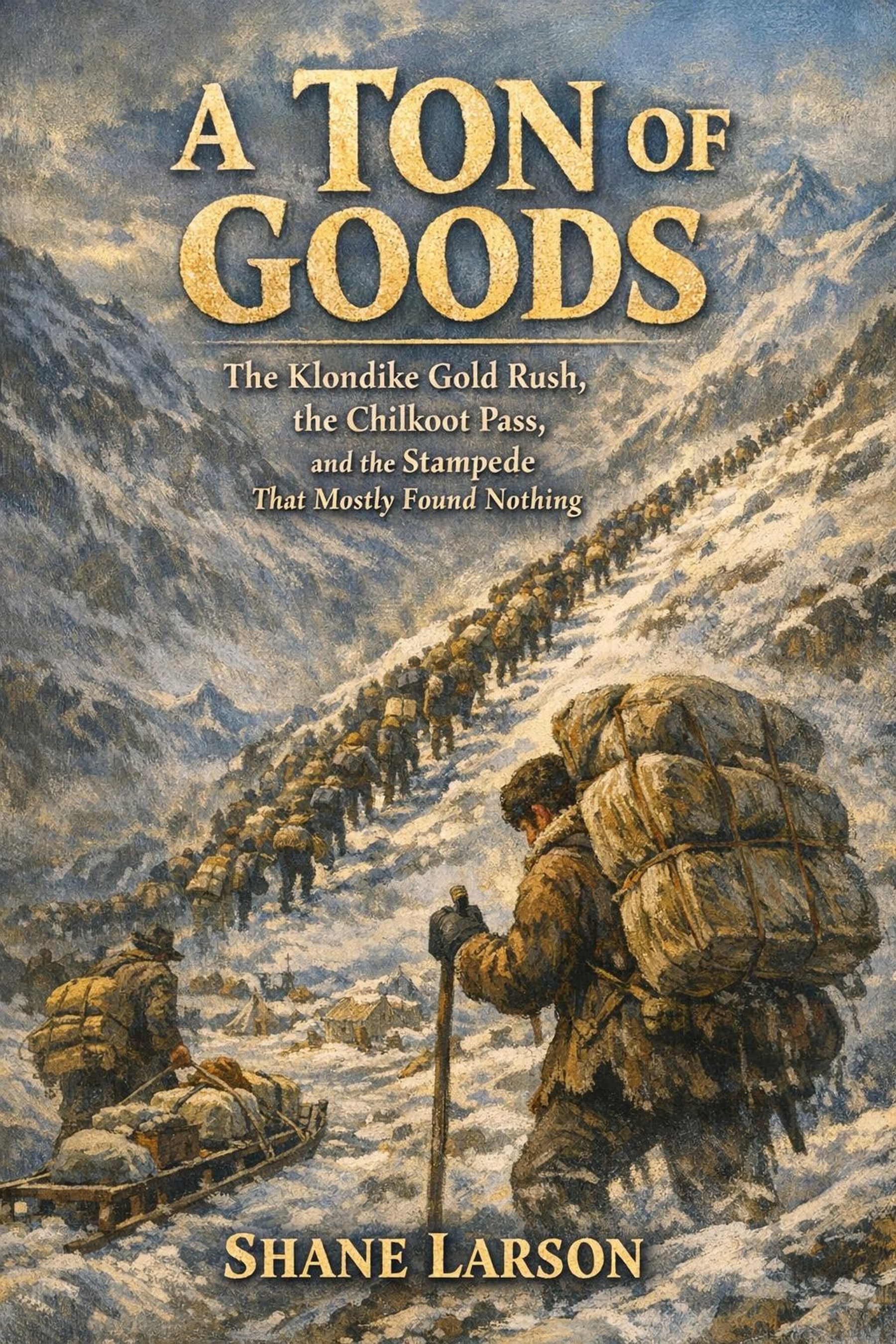
A Ton of Goods
The Klondike Gold Rush, the Chilkoot Pass, and the Stampede That Mostly Found Nothing
By Shane Larson
About This Book
In the summer of 1887 a Tagish man named Keish carried 156 pounds of bacon over the Chilkoot Pass for a Canadian government surveyor, who wrote it down because nobody else on the trail could lift it. The pass was a trade road then, not a legend. The Tlingit had controlled it for generations and charged for its use, and about 120 of them packed William Ogilvie's six tons of gear that season. Nine years later Keish, whom the miners called Skookum Jim, was standing in Rabbit Creek with his sister, his nephew and his sister's American husband when one of them saw gold in the gravel.
The most famous gold rush in history started on a Tagish fishing trip, and the people who knew the country best were the ones already working it.
That is where this book begins. The Klondike Gold Rush is usually told from Seattle outward: the steamer, the headlines, the clerks quitting their jobs. Told from the pass inward, it is a story about a mountain climbed thirty or forty times, a border nobody had agreed on, 500 miles of river, and a fishing camp whose people were moved three miles downstream so a city could be built on the spot.
The Rush That Arrived Too Late
The rich creeks were staked before the world knew they existed. Bonanza and Eldorado were claimed in the autumn and winter of 1896 by the few hundred prospectors already in the Yukon basin. By the time the Excelsior and the Portland carried the first gold to San Francisco and Seattle in July 1897, nothing worth owning was left on either creek. Roughly 100,000 people set out anyway. Between 30,000 and 40,000 reached Dawson City; perhaps half of those went out to the creeks, a few thousand found gold, and a few hundred got rich.
So the stampede was about getting in. The North-West Mounted Police, in the Yukon since 1895, admitted nobody over the summits in 1898 without about a year's food, and with tools, a stove and a tent the outfit came to roughly a ton. The last pitch of the Chilkoot could be climbed only on foot, up something like 1,500 steps cut in the ice, with 50 or 60 pounds on your back; then you went down and did it again. Tlingit and Tagish packers charged 15 to 20 cents a pound in the summer of 1897 and 30 to 40 by autumn. On the White Pass, the neighboring route sold as fit for horses, about 3,000 pack animals died between August and October.
Those who got over built boats. The ice left Lake Bennett on 29 May 1898, and by season's end the police had registered 7,124 of them, carrying 28,000 to 30,000 people toward Dawson. The book follows them in by the route they took, with the figures Tappan Adney, Sam Steele and the police reports give and their disagreements left standing. It keeps the border in view too: the gold was in Canada, the door was in the United States, and the contrast between a town run by a confidence man below the summit and a customs house with a Maxim gun above it is argued rather than assumed, with the Mountie legend tested against the Gold Commissioner's office.
Why I Wrote This
I live in Alaska, in a cabin I built with hand tools, a long way from a road. Every autumn I work out what the winter needs and how it gets here, and I have carried enough of it to know what 50 pounds feels like on the thirtieth trip. So the Klondike story that interested me was never the gold. It was the ton of goods: a hundred thousand people solving, badly and at great cost, the problem of moving a year of food into a country with no road and six months of winter.
The other thing that held me was the first chapter. The Chilkoot was a Tlingit trade route with a toll on it long before anyone called it the Golden Stairs, and the man who found the gold had been packing bacon over it for white surveyors a decade earlier. The usual accounts put those people in the background. The record does not.
Frequently Asked Questions
Is this a narrative history or an academic study of the Klondike Gold Rush?
Narrative history, organized along the route the stampeders took. It is built from public-domain eyewitnesses (Adney, Ogilvie, Steele, the police reports, the newspapers) and from Tagish and Tr'ondëk Hwëch'in testimony in the published oral histories, and every figure is sourced in the prose and hedged where the sources disagree.
Who really found the gold on Bonanza Creek?
The book does not pretend to settle it. George Carmack said he did; the family of Keish (Skookum Jim Mason) said Keish did, or that Shaaw Tláa (Kate Carmack) did while fetching water. Both are given with their witnesses and their reasons, and the chapter closes with what can be said.
Does it cover Skagway and Soapy Smith?
Skagway and Dyea get a full chapter as American towns in their own right. Soapy Smith gets a few paragraphs there, including his death on Juneau Wharf on 8 July 1898, and no more; he is being held for a book of his own.
How does it treat the First Nations side of the rush?
As part of the main story. The Tagish discovery party, the Tlingit packers who set the price of the pass, and the Hän of Tr'ochëk, whose fishing camp became Dawson, carry equal weight with the settler memoirs. The names used are the ones those nations use, with the familiar English forms alongside.
How long is the book, and is it in Kindle Unlimited?
About 74,500 words: thirteen chapters in four parts, an introduction and conclusion, and three appendices (the routes north, a timeline from 1880 to 1903, and a who's who). It is released wide through Draft2Digital, so it is not in Kindle Unlimited; it is on the major ebook stores, in paperback, and as an audiobook.
If You Liked This, You Might Like
- No Law Below the Pass — the Skagway of Chapter 5 as a novel: a stampeder robbed of his outfit in a town where the thieves were the government.
- The Alaska Purchase — how the coast with the passes came to be American while the gold stayed Canadian, and why Alaska had almost no government when the stampede landed.
- Deadwood — the American gold camp the Mounties were determined Dawson would not become, miners' courts and all.
- The Montana Vigilantes — a rich gold camp with no law at all, the American comparison Chapter 9 draws against the Mounties' Dawson.
The gold was found by the people whose country it was and claimed by the people already there. What the hundred thousand brought north was a ton of goods apiece, and what they left behind is the story this book tells.
What You'll Learn
- Keish, Shaaw Tláa and Káa Goox as the discovery party they were, with Carmack's account and the Tagish family's account set side by side and left unresolved.
- The arithmetic of the pass: what a ton of goods contained and cost, what the packers charged month by month, and why one outfit meant walking two thousand miles before it reached the lakes.
- Two passes compared from the beach, and why the one advertised as easier became the Dead Horse Trail.
- The Palm Sunday avalanche of 3 April 1898, and the whipsaw camps at Lindeman and Bennett, where partnerships broke over a plank of green spruce.
- Dawson in 1898: sixteen to thirty thousand people on a swampy flat, gold dust weighed at every counter, typhoid, and entrepreneurs like Belinda Mulrooney and Martha Black who did better than the miners.
- Chief Isaac's decision to move the Tr'ondëk Hwëch'in to Moosehide in 1897, the songs he sent to Alaska for safekeeping, and how his people tell it now.
- Who kept the money: the King of the Klondike who died by his woodpile, the Berrys who did not, and what the stampeders spent set against what the creeks produced.
- The exodus to Nome in August 1899, when about 8,000 people left Dawson in a week to be early for once.
New Wild West / American Frontier History releases and free chapters — no spam, unsubscribe anytime.
More in This Genre
View all →