Paris Had a Name for Poison Bought to Hurry an Inheritance. Louis XIV's Police Found Out Who Was Selling It.
8 min read
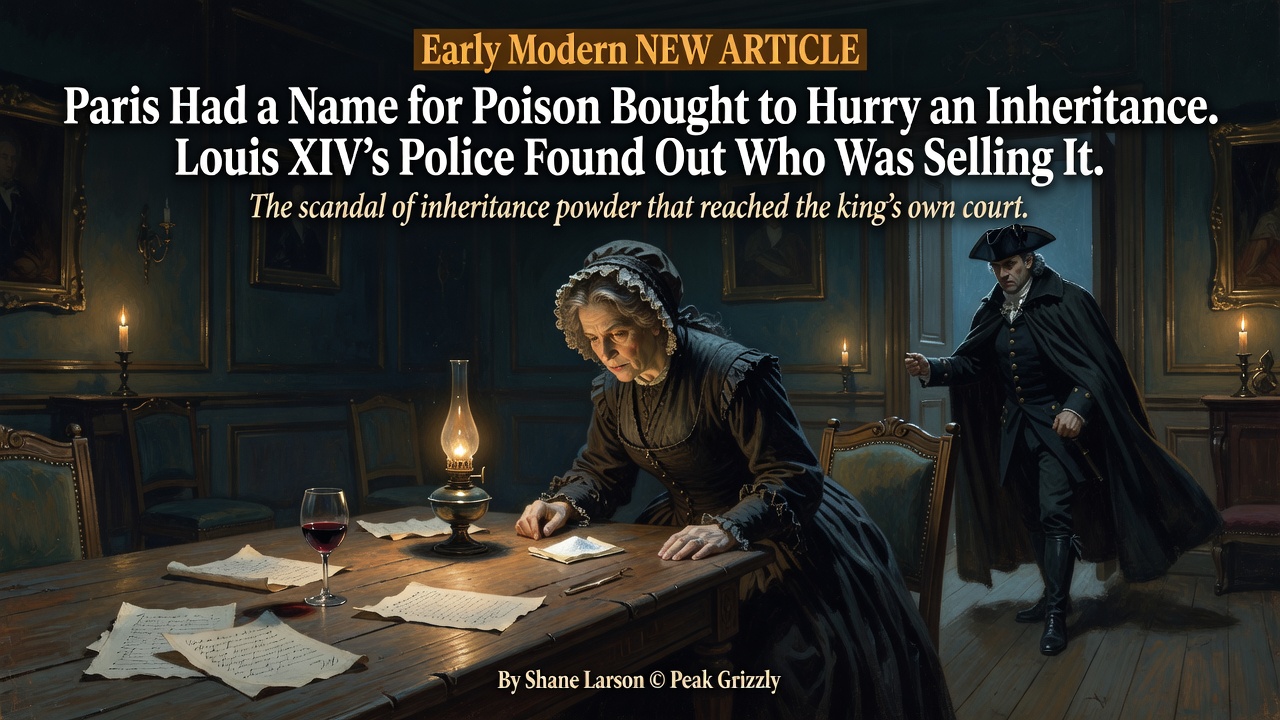
In the Paris of the 1670s, a small packet of white powder bought to shorten a rich relation's life had a name. People called it poudre de succession, inheritance powder. The phrase was a joke before it was an indictment, the kind of thing said over supper about a nephew whose uncle had died conveniently. By the end of the decade it was being read into the record of a royal tribunal, and the people who had made the joke were discovering how much of it was true.
What the powder was
Mostly, it was arsenic. White arsenic, arsenic trioxide, was sold freely by apothecaries and grocers for killing rats, and nothing in French law before 1682 required a seller to ask who was buying it or why. A few grains in soup, in wine, or in a medicinal enema, repeated over weeks, produced a wasting illness with vomiting and stomach pain that no physician of the period could tell from a natural one. Corrosive sublimate, a mercury compound, did the same work faster and was easier to taste. Antimony, vitriol and preparations of toad appear in the depositions too.
The crucial fact about all of it is that it could not be proved. There was no reliable chemical test for arsenic in a body until the nineteenth century. A suspicious physician could open a corpse, feed suspect food to a dog, or heat a residue and sniff for the garlic smell of arsenic, and none of that would stand up against a family that said the deceased had simply sickened and died. An heir with a little patience was, as a practical matter, safe. That is what made the phrase funny, and it is what made the trade possible.
Who sold it
The sellers were, for the most part, fortune-tellers, and that was not a cover story. The devineresses of Paris made most of their money from palms, horoscopes and the interpretation of dreams, at prices from a few sous to a few livres. The dangerous services were a sideline for the client who asked: love charms, with cantharides as the common ingredient; abortions, which were a capital crime under a statute of 1556; masses said for a purpose by priests who had no parish and needed the fee; and, for the rarest and richest client, the powder. The same house might offer all of it. The best-known of them, Catherine Monvoisin, called La Voisin, received important clients in a garden pavilion near the porte Saint-Denis wearing a crimson velvet robe embroidered with eagles, and took a broker's share for introductions to the midwives, priests and chemists who did the specialised work.
Her clients were not shopgirls, or not only shopgirls. That was the boast, made by one of her colleagues, Marie Bosse, at a supper late in 1678 after too much wine: her customers were duchesses and marquises, princes and great lords, and three more poisonings would let her retire. A lawyer at the table reported it.
The men who went looking
The reason the boast became a case is that Paris, by 1678, had something it had not had twelve years earlier: a police force. Until March 1667 nobody in the city of half a million had the job of knowing what went on. The office of lieutenant of police was created that spring and given to a provincial magistrate named Gabriel Nicolas de La Reynie, who lit the streets with some three thousand candle lanterns, cleared the Cour des Miracles, put paid informers in every quarter, and built an archive of names that could be searched.
He treated Bosse's remark the way a careful official treats a drunken boast. He tested it. The wife of one of his officers called on Bosse with a story about a husband she could not bear, had her fortune read, and on a later visit was sold something to put in his food. It was examined and found to be poison. Bosse was arrested on 4 January 1679. Ten weeks later La Voisin was taken as she left Mass, and in April the king created a special commission at the Arsenal, with no appeal from its sentences, to try what the prisoners were saying. Paris called it the Chambre ardente, the burning chamber, after the heresy courts of the previous century; the torchlit, black-draped room of legend appears nowhere in the surviving papers.
How far it went
Prisoners in the keep at Vincennes learned quickly what their questioners wanted, and what a great name could buy. By the autumn of 1679 the depositions were pointing at the court. On 23 January 1680 the commission issued warrants for the comtesse de Soissons and the duchesse de Bouillon, both nieces of Cardinal Mazarin and both once close to the young king, and for the maréchal de Luxembourg, a marshal of France, who walked into the Bastille the next day. Soissons fled to Brussels and never came back. An arrest order for the playwright Racine, accused by La Voisin of poisoning an actress in 1668, was drawn up and never used. La Voisin herself was burned on the Place de Grève on 22 February 1680, having named nobody of the first rank.
Inheritance Powder
Her daughter did. In July 1680 Marguerite Monvoisin told the commission's investigators that Madame de Montespan, the king's mistress of twelve years and the mother of seven of his children, had been her mother's client since the 1660s, buying powders to hold the king's affection whenever she feared for it. Other prisoners added worse: sacrilegious rites, and a plan early in 1680 against the king's new favourite and the king himself. One of those witnesses took her story back on the way to the scaffold. La Reynie, reading the rest, wrote down that the prisoners had every reason to produce exactly such a name at exactly such a moment. He was the man whose case it would have made.
What the king did
Louis XIV did not deny the testimony, which would have meant engaging with it, and he did not have the witnesses killed, which would have meant a trial, and a trial is where testimony gets repeated. He suspended the commission's sittings on the Montespan matters in the autumn of 1680, had the dangerous prisoners examined by two men alone, let the tribunal resume the next spring to finish with the people who did not matter, and dissolved it in July 1682. The prisoners who had named his household went that summer by lettre de cachet, a sealed royal order no court could review, to fortresses at Belle-Île, Besançon, Salces and Villefranche, where the most dangerous were chained to the wall and the governors were authorised to punish any who spoke of why they were there. The abbé Guibourg died that way in 1686. Marguerite Monvoisin was never known to have been released.
The commonly cited tally of the whole affair runs to some 442 accused and 36 executed, and the fortune-tellers account for the executions. The duchesses went home. Montespan kept her apartments at Versailles for another eleven years.
The same month the commission closed, the king issued an edict that regulated the sale of arsenic, required apothecaries to keep a signed register of who bought what, and, in its clauses on sorcery, quietly stopped French courts from asking whether the devil had been present at a crime. Magic became fraud and sacrilege, both still punishable, but the question of the devil would no longer be put. Historians of the European witch trials count that edict among the landmarks of their ending.
Why the files survived anyway
On 13 July 1709 the king, then seventy and in the worst year of his reign, had the commission's sealed archive brought to him and burned it in his presence. He was a month too late. La Reynie had died in June, at eighty-four, and his own working papers, the interrogation notes, the copies of depositions, the lists of doubts in his own hand, were not among those the king sent for. They went into the archives of the Bastille, survived the fortress's fall in 1789 by being scattered rather than burned, and were printed in the 1870s. Everything anyone has written about the Affair of the Poisons since rests on the policeman's copies of what the king thought he had destroyed.
What cannot be settled is whether Montespan did more than buy the trade's most ordinary product, and the reason it cannot be settled is not that the witnesses lied, though some of them did. It is that the one authority which could have tested their stories, by confrontation and by comparing dates against the court's own records, decided not to. A monarchy built on one man's person could not separate a scandal in the king's household from a scandal in the state, so the king left the question open, the only move that cost him nothing he could see. The price was paid in fortresses by people whose names he did not need to remember.
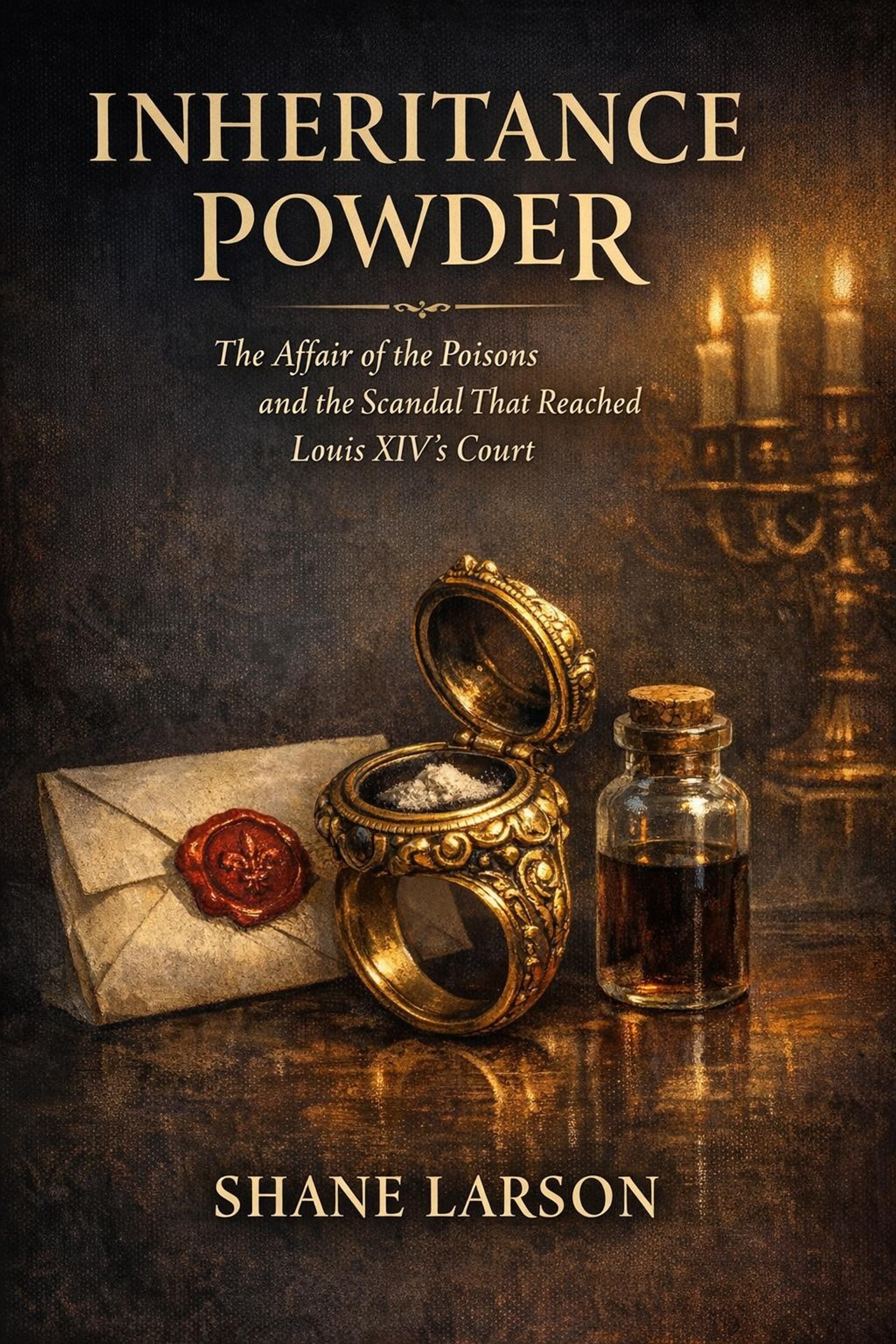
Inheritance Powder: The Affair of the Poisons and the Scandal That Reached Louis XIV's Court tells the whole investigation in the order the policeman conducted it, from the Brinvilliers trial of 1676 that first taught Paris to fear its own kitchens, through the arrests, the tribunal and the stake, to the testimony the king refused to let any court hear and the edict that ended witchcraft as a crime in France. Every deposition carries who gave it and under what pressure, the historians' disagreement is set out rather than settled, and the verdict is left to the reader. It stands beside this house's The Thirty Years' War, the war that made the France of Louis XIV possible.
Inheritance Powder
New posts and releases, straight to your inbox. No spam, unsubscribe anytime.