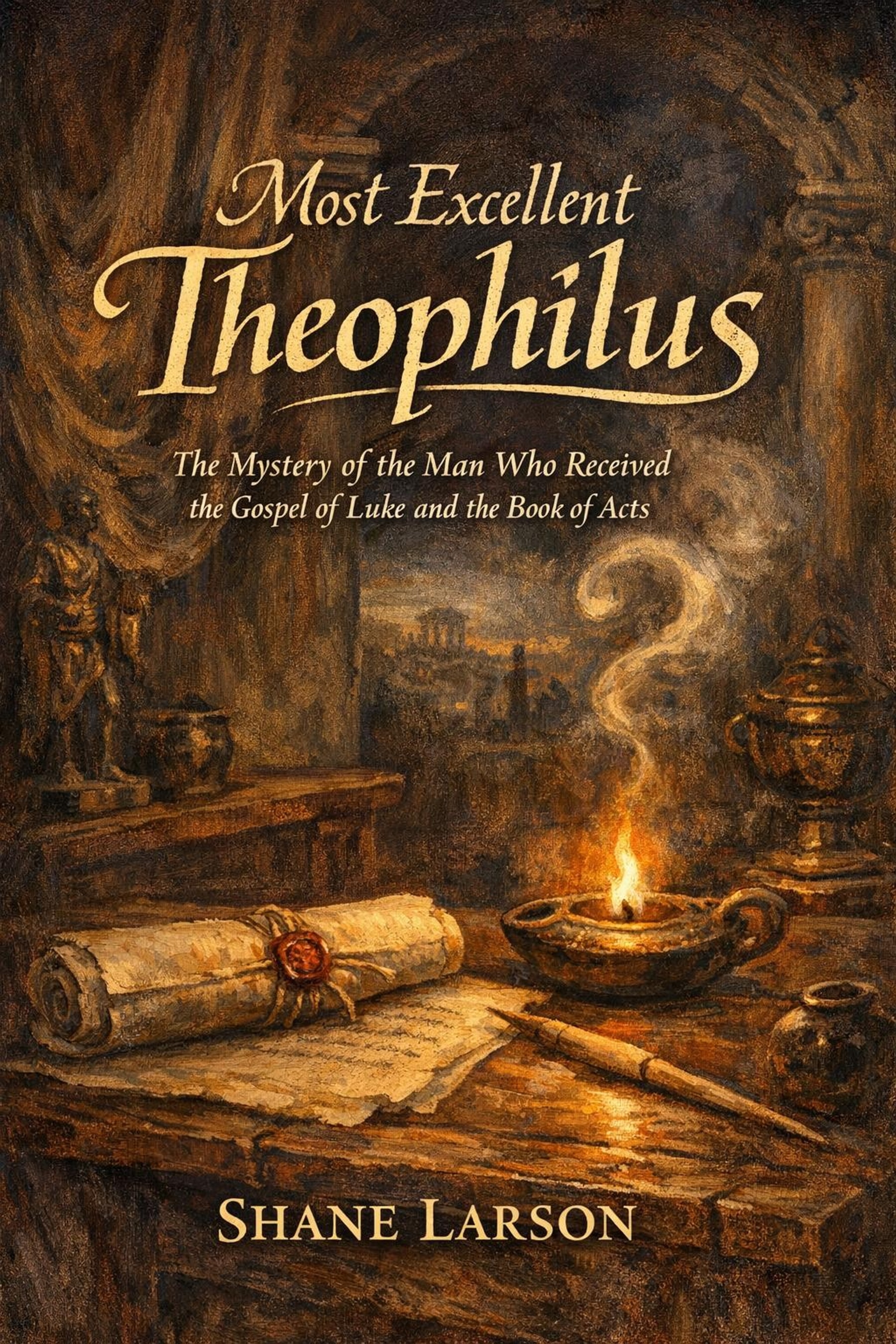
Most Excellent Theophilus
The Mystery of the Man Who Received the Gospel of Luke and the Book of Acts
By Shane Larson
About This Book
In the 230s, in the port city of Caesarea, a preacher named Origen reached the third verse of Luke's Gospel and stopped on a name. His congregation sat in the city where Paul had been held for two years and where Luke, by the traditional account, gathered much of his material. If any church on earth could have said who "most excellent Theophilus" was, it should have been the church at Caesarea. Origen did not say. He told his hearers instead that everyone who loves God may take the name as his own.
That is the earliest surviving comment on the dedication, and it is already a confession. Less than two centuries after Luke wrote, the man he wrote for had gone beyond recall. He is named twice, in Luke 1:3 and Acts 1:1, with a title Luke otherwise reserves for Roman governors, and then the record falls silent. Yet the two books addressed to him make up more than a quarter of the New Testament, from the angel's visit to Mary to the hired house in Rome. The church's one history of its own first thirty years was a gift to a man about whom the church kept nothing but his name.
Five Doors into the First-Century Church
Most Excellent Theophilus: The Mystery of the Man Who Received the Gospel of Luke and the Book of Acts treats the question as an unsolved problem with real evidence attached to it. Five answers have been seriously proposed, and the book works through each as a case file: who proposed it, what speaks for it, what speaks against it, and what can fairly be said.
The investigation starts with the writer, because every inference about the reader passes through him. Part One sets out what is known of Luke, the "beloved physician" of Colossians 4:14, what the sudden "we" in Acts means for his presence on Paul's voyages, and how his preface compares with those of Thucydides, Josephus and the Greek medical writers. Part Two reconstructs the world a dedication belonged to: how a book circulated in an empire without publishers, what the honorific kratistos implied about a man's standing, and what a new believer was taught in the first generation.
Only then do the candidates get their hearing: the symbolic reading of Origen and Ambrose; Theophilus son of Annas, high priest from about AD 37 to 41; the Gentile of rank most modern scholars favour; the Roman official who might have read Luke while Paul awaited his hearing before Caesar; and the nobleman of Antioch who, in a fourth-century romance, gives the hall of his house to be a church. Each door opens onto a different room of the earliest church, and the book spends as long in the room as in the doorway.
It is written for Christian readers. Scripture is quoted from the King James Version and treated with reverence, and Luke is taken at his word as an honest and careful historian. The book does not argue with the resurrection or the miracles. The open question is who first unrolled these scrolls, and that can be investigated without setting any part of the faith on the table beside it.
Why I Wrote This
I had just finished a book about Paul, and Luke kept getting in the way of it. Every time Acts turned to "we," there was a second man on the deck taking notes, and I wanted to know who he was taking them for. The dedication sits on the first page of the third Gospel, and I had read past it my whole life. When I finally stopped on it, the silence after it was what hooked me: a quarter of the New Testament has an addressee, and the church lost him within a few generations. I also wanted, this time, to write for the people who hold these books to be Scripture, and to show that the history can be done rigorously without asking them to leave that at the door.
Frequently Asked Questions
Who was Theophilus in the Bible?
He is the man to whom Luke addressed both his Gospel (Luke 1:3) and Acts (Acts 1:1), called "most excellent" in the first and simply "O Theophilus" in the second. The name is Greek and means "friend of God" or "loved by God." Scripture says he had already been instructed in the faith, and records nothing else about him.
Does the book say who Theophilus was?
No, and it says so in the Introduction. Two verses, a title and the conventions of ancient dedications are enough to describe the kind of man he was, not to name him. The book ranks every serious candidate honestly, and the Conclusion sets out what can and cannot be said.
Is this book written from a Christian perspective?
Yes. It is written for believing readers, quotes Scripture from the King James Version, and treats Luke as the careful historian he claimed to be. It does not argue against the resurrection or the miracles, and it does not raise sceptical theories about Luke or Acts even to refute them. Dissenting scholarly views on dating and authorship are summarised fairly where they bear on a theory.
Was Theophilus the high priest in the Gospel of Luke?
A real high priest named Theophilus, son of Annas, held office in Jerusalem from about AD 37 to 41, and an ossuary naming his granddaughter was published in 1986. The book gives that case a full chapter and finds it possible but unlikely, chiefly because Luke explains Jewish customs and Judean geography that a son of Annas would have known from childhood.
Do I need to read Paul of Tarsus first?
No. The two books stand alone. Paul of Tarsus tells Paul's life from his letters outward; this book follows Luke, his companion, and touches Paul's story only where Luke was present or a candidate is at stake. The stances also differ: Paul of Tarsus was written on neutral ground, and this book for Christian readers.
If You Liked This, You Might Like
- Paul of Tarsus — the direct companion: the same roads, the same imprisonment at Caesarea and the same voyage to Rome, from the other man's side.
- Masada — the Judaea of Felix, Festus and the house of Annas, and the war that destroyed the temple where Luke's Gospel opens and closes.
- Nero — the emperor to whom Paul appealed, under whose reign Acts falls silent, and whose fire of 64 divides the early and late datings of Luke's work.
- Aksum — the kingdom behind the Ethiopian treasurer of Acts 8, one of the believers in high places the book weighs when asking what kind of man Theophilus was.
The man disappeared, and nothing that was written for him did. This book follows the evidence as far as it goes, calls legend by its name, and ends where Luke's first reader is still standing: taught, and wanting to be sure.
What You'll Learn
- A long sentence: why Luke 1:1–4 is the most polished Greek in the New Testament, and what its loaded words (*autoptai*, *kathexēs*, *asphaleia*) meant to a first-century reader.
- "We": the three passages where the narrator of Acts joins the ship, and what Luke's two years in Judea while Paul was held likely gave him.
- Patrons and papyrus: how an author's work reached readers in a world without publishers, and why Luke's history came in two scrolls of nearly equal length.
- The house of Annas: a priestly dynasty of five sons and a son-in-law, an ossuary inscribed "granddaughter of Theophilus the high priest," and the strongest objection to the theory, drawn from Luke's own prose.
- A brief for the defense: why Acts ends with Paul preaching "no man forbidding him" and no verdict, how a Roman appeal worked, and whether a legal brief would ever have included the Nativity.
- From two scrolls to Scripture: Marcion's cut-down Luke, Irenaeus's fourfold Gospel, the papyrus P75, and how a book addressed to one man came to be read aloud to all.
- Three appendices: a dossier of every candidate with a comparison table, a gazetteer of the cities of Luke–Acts, and a timeline from the birth of Jesus to the canon lists of the fourth century.
New Ancient History releases and free chapters — no spam, unsubscribe anytime.
More in This Genre
View all →