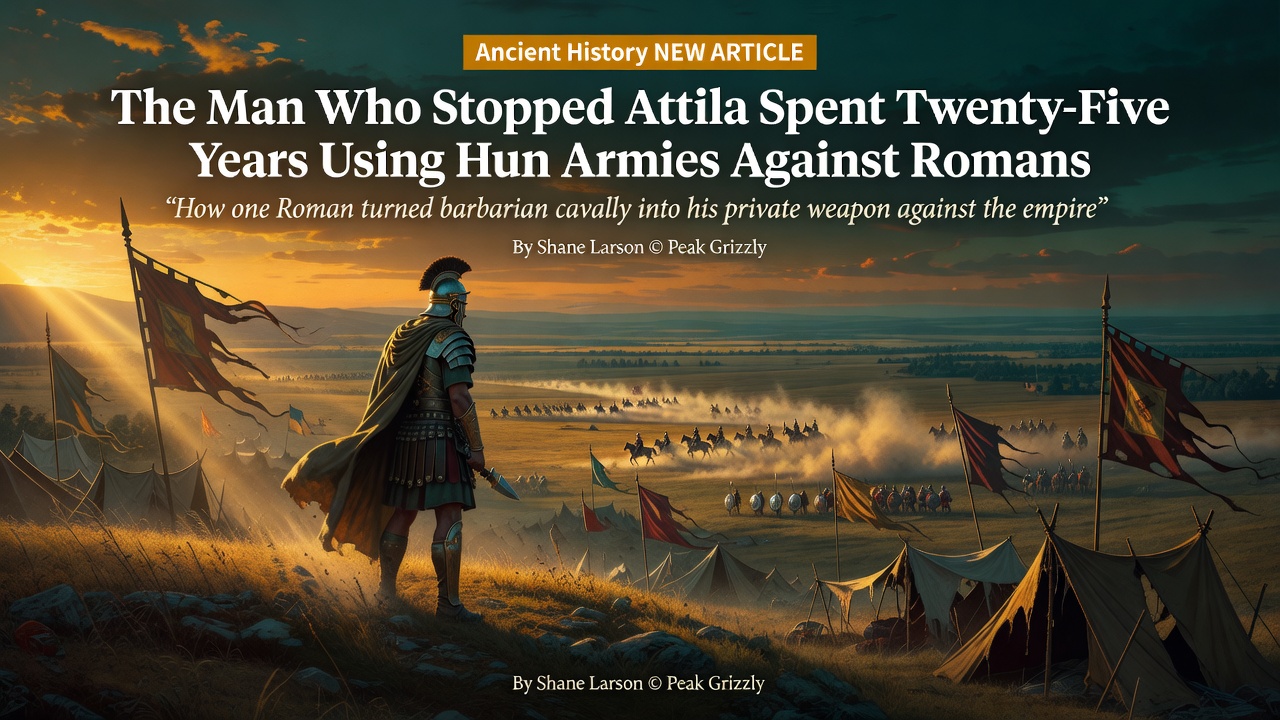
The Man Who Stopped Attila Spent Twenty-Five Years Using Hun Armies Against Romans
November 6, 2026 · 8 min read
In the spring of 425 an army of Huns came down into Italy under a Roman officer named Flavius Aetius. It had been hired to save a usurper. John, a senior palace official, had taken the Western throne when Honorius died in August 423, and the Eastern emperor Theodosius II had sent a fleet and an army to remove him in favor of his own cousin, a six-year-old named Valentinian. John sent Aetius north across the Danube with gold. Aetius had lived among the Huns as a hostage in his youth, and he came back with soldiers. Philostorgius, a church historian whose work survives only in a later summary, puts the number at sixty thousand. Nobody who has worked on the period believes that figure, and it is worth saying at the outset that no army total in this story can be trusted. The chroniclers guessed, rounded and exaggerated.
He arrived three days after John had been beheaded at Aquileia. The Eastern troops already held Ravenna. What Aetius did next tells you most of what you need to know about him. He fought them anyway, forced a settlement, sent the Huns home with their pay, and was given a command in Gaul by the regent Galla Placidia, the mother of the child he had marched to depose. A general who could bring Hun cavalry into Italy, and who was the only Roman who could also send it away, was too dangerous to kill and too useful to waste. The court at Ravenna understood the terms, and for the next twenty-nine years it lived with them.
The Hun card
Aetius is remembered for one thing. In June 451, on the Catalaunian Plains in northeastern Gaul, he commanded the coalition that stopped Attila. Every account of Attila gives him that scene and leaves him there: the steady Roman hand, the last defender of the West against the Huns.
The record of the quarter century before 451 does not fit that picture. In 432 Aetius lost a civil war to a rival Roman general outside Rimini, fled across Pannonia to the Hun king Rua, and came back the next year with Hun backing to take supreme command of the Western army. The price, on the usual reading of the sources, was Roman territory on the middle Danube, though how much and exactly where is disputed. In 436 and 437 Hun forces destroyed the Burgundian kingdom on the Rhine; Hydatius, a bishop in the far northwest of Spain who kept a year-by-year chronicle, gives twenty thousand dead, another number to hold at arm's length. Whether Aetius directed those Huns or merely profited from what they did is a question historians still argue. The slaughter was thorough enough that it became, centuries later, the last act of the Nibelungenlied, where Gundahar the Burgundian king is Gunther and the Hun king Etzel is Attila. In 439 Aetius's lieutenant Litorius led Hun cavalry against the Visigoths at Toulouse and was destroyed by them. Aetius sent his own elder son, Carpilio, to live at Attila's court, and he sent Attila secretaries from his own staff; Priscus, an Eastern diplomat who visited that court in 449 and whose account survives only in excerpts, met the Western envoys there.
For twenty-five years the Huns were not Aetius's enemy. They were his army. His authority inside the empire rested on the one thing no other Roman general of his generation possessed, which was personal access to Hun military force, and the court tolerated a man it could not remove because the alternative was that force arriving at the Alps with nobody to call it off.
It worked as long as there were several Hun kings, each of whom could use a Roman friend. It stopped working when there was one who did not. Bleda, Attila's brother and co-ruler, died around 445. Attila, ruling alone, had the Eastern empire paying him tribute and no need of a Roman patron. When he turned west in 451, the force Aetius had built his career on was on the other side of the field, and Aetius met it with Visigoths, Alans, Franks and Burgundians, the peoples he had spent thirty years fighting, settling and bargaining with. Bringing them to a single field at all is the real achievement of 451. Jordanes, who wrote the main narrative of the battle a century later and from a Gothic point of view, gives 165,000 dead on the two sides. The figure is impossible. Jordanes also says that Aetius persuaded the Visigothic prince Thorismund, whose father had been killed in the fighting, to go home rather than finish the Huns, so that the Goths would not grow too strong with no Hun counterweight. Whether that is Aetius's calculation, Jordanes's Gothic grievance, or both, the record does not let us decide.
Aetius
Two men outside Rimini
Which brings us to the phrase. Procopius of Caesarea, writing in Constantinople in the 550s, needed to introduce the Roman commanders of the 420s to readers who had never heard of them, and he did it with a sentence that has defined Aetius ever since: there were two generals, Aetius and Boniface, both so able that a man would not be wrong to call either of them "the last of the Romans." The phrase, in H. B. Dewing's 1916 Loeb translation, has been lifted out of its sentence and hung on Aetius alone for two centuries. The sentence does not support that. Procopius gave the title to two men, in the same breath, and he gave it at exactly the point in his story where the two were about to destroy each other.
Boniface was count of Africa, the man who held Carthage and with it the grain and taxes that fed Rome and paid its soldiers, and a friend and correspondent of Augustine. In 427 he was declared a public enemy by the court at Ravenna, fought off the expeditions sent against him, and was then forgiven. Procopius tells a story to explain the breach: that Aetius forged letters to set Placidia and Boniface against each other, and that Boniface, cornered, invited the Vandals across from Spain. Most modern historians reject both halves of it. The Vandals crossed in 429 under Gaiseric for their own reasons, and the forged-letters tale has the shape of an explanation composed after the disaster. But the disaster is real. Hippo Regius was besieged in 430 and Augustine died inside it. In 432 Placidia recalled Boniface from Africa and gave him supreme command of the Western army over Aetius's head.
So in the summer of 432 the two best soldiers in the West met near Rimini and fought a pitched battle against each other, while the Vandals held Numidia. Prosper of Aquitaine, a contemporary who disliked Aetius in those years, says Boniface won. Hydatius agrees. Boniface died of a wound within months; Aetius, the loser, fled to the Huns and was master of the West inside eighteen months. Carthage fell to Gaiseric on 19 October 439, while Aetius's army was in Gaul and his attention was on Toulouse. The West never got Africa back, and without Africa it could not pay for an army. Valentinian's own laws of the 440s admit as much.
That is why there are two names in Procopius's sentence. Boniface was the general of Africa and Aetius was the general of Gaul, and between them they held the two provinces the West could not do without. The court brought them together at Rimini, and they spent on each other the strength the empire needed in both places.
The right hand
Attila died in 453. Within a year his sons had lost his empire at the Nedao. The Western court was delivered, and Aetius, at sixty-three, had become something he had never been before: removable. He pressed the emperor to marry his younger son Gaudentius to Valentinian's daughter, a match that would have made the general's grandson heir to a dynasty that held the throne only because a Hun army had arrived three days late. Whether he meant it as a bid for the succession or as insurance for his family, the sources do not say.
The account of what followed comes from Priscus, preserved in the excerpts of John of Antioch, a seventh-century compiler, with a more colorful parallel in Procopius. On 21 or 22 September 454, the chronicles differing by a day, Aetius was in the palace laying out the state of the finances and pressing the marriage again. Valentinian rose, accused him of treason, drew a sword and struck. The eunuch Heraclius, who had a blade under his robes, struck with him. Aetius died in the room. Procopius adds the epitaph, and it should be taken as his anecdote: a courtier, asked afterward whether the thing had been well done, said he could not judge, but that the emperor had cut off his own right hand with his left. Whoever composed the line, the next eighteen months bore it out. On 16 March 455 two of Aetius's former guardsmen killed Valentinian on the Campus Martius at Rome. In June the Vandals sacked the city.
Procopius was not paying Aetius a compliment so much as writing an obituary for a type: the native Roman commander who ruled through the state's own offices and could still bring the barbarians to heel. After 455 the generals who ran the West were Ricimer, Gundobad and Odoacer, and none of them was that. Aetius and Boniface were the last two, and the title belongs to both because the loss was both of them.
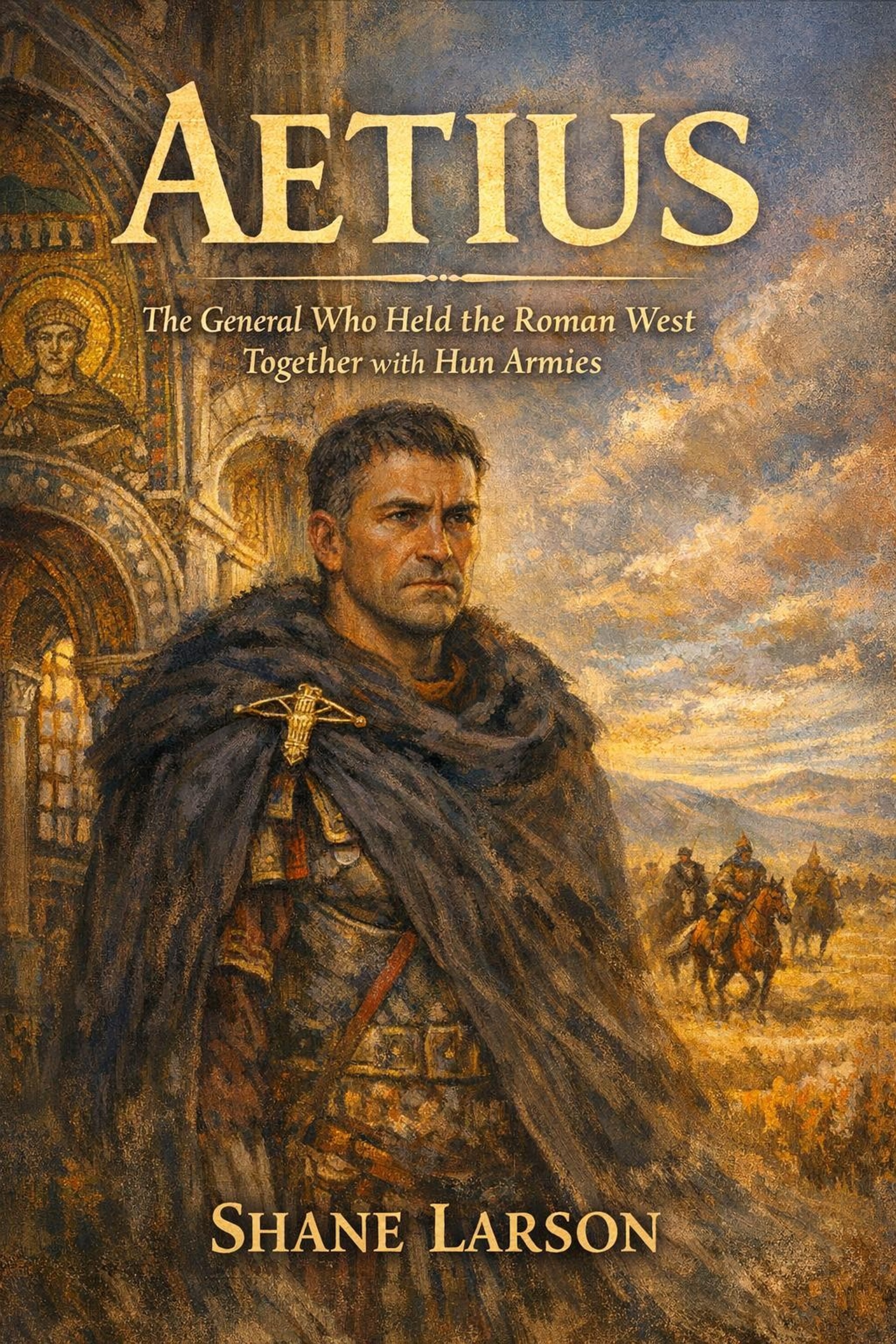
Aetius: The General Who Held the Roman West Together with Hun Armies is a narrative biography of Flavius Aetius from his boyhood as a hostage among the Goths and the Huns to the sword in the palace, with Boniface as a second protagonist and the thirty years before Attila as its subject. Every scene names its witness, every disputed point is presented as a dispute, and no army is given a size the sources cannot bear. It stands beside this house's Attila, which tells 450 to 453 from the Hun camp.
Aetius
New posts and releases, straight to your inbox. No spam, unsubscribe anytime.