A High Priest Named Theophilus Ran the Temple While the Apostles Preached in It. Was He the Man Luke Wrote For?
8 min read
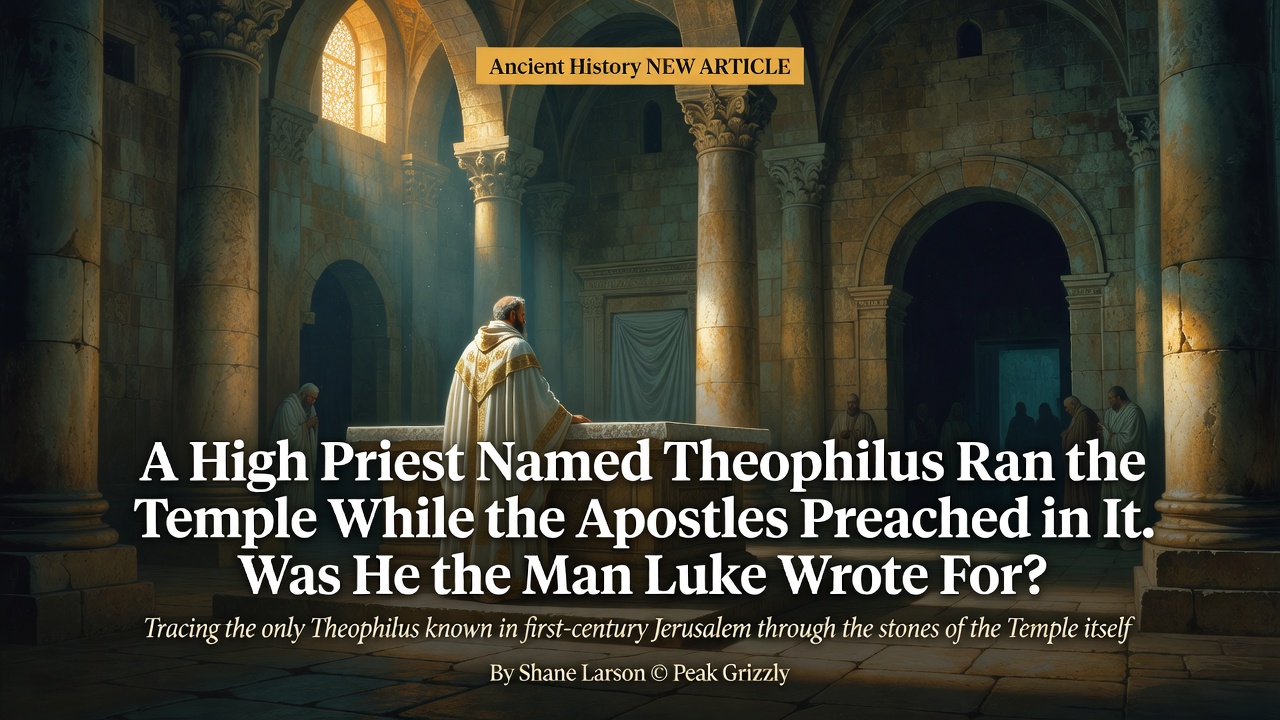
In the spring of AD 37 the Roman governor of Syria, Lucius Vitellius, came up to Jerusalem for a feast. He was marching south against the Nabataean Arabs, and at the request of Judea's leading men he had sent his legions round by another road, because their standards carried images the law forbade. He went up to the city with Herod Antipas to offer sacrifice. Josephus says he stayed three days, and that while he was there he took the high priesthood from a man named Jonathan and gave it to Jonathan's brother. On the fourth day the news arrived that the emperor Tiberius was dead.
The brother's name was Theophilus.
That is why a high priest who gets two short mentions in Josephus has a following among readers of the New Testament. Luke opens his Gospel with a dedication: it seemed good to him "to write unto thee in order, most excellent Theophilus, That thou mightest know the certainty of those things, wherein thou hast been instructed" (Luke 1:3–4). Acts opens by picking the story up for the same man: "The former treatise have I made, O Theophilus" (Acts 1:1). Then the name is never heard again, not in Acts, not in any letter, not in any church's memory. Luke and Acts together make up about a quarter of the New Testament, longer than all of Paul's letters put together, and they were written for a man nobody can place.
Theophilus son of Annas is the only person of that name whom any surviving record puts in Jerusalem in the years when the church began. He held the highest office in Jewish religious life while the apostles were still teaching in the temple courts. And a limestone box inscribed with his title and his granddaughter's name sits in a collection today. For some readers that is too much coincidence to pass over. It is worth seeing exactly what the evidence is.
Four years in office, in a family that held the temple for half a century
Theophilus belonged to the most powerful priestly house of the period. His father, Annas, was appointed high priest in AD 6, the first year of direct Roman rule, and though the Romans removed him in AD 15 he remained the senior man of his family for decades. Luke knows this. When he dates the start of John the Baptist's preaching he ends his list of rulers with "Annas and Caiaphas being the high priests" (Luke 3:2), two names for one office, because that is how power actually lay. Caiaphas was Annas's son-in-law. Five of Annas's sons held the office after him, something Josephus, himself a priest, says had never happened to any other high priest.
Theophilus held it from 37 to 41, and they were not quiet years. In 39 or 40 the emperor Gaius ordered a statue of himself set up in the temple, and the crisis that followed ended only with his murder in January 41. Theophilus was high priest for the whole of it. Josephus does not say what he did, and it would be dishonest to invent a part for him. Later in 41 Herod Agrippa I, newly made king, gave the office to a rival family, and Theophilus disappears from the record.
A bone box with his granddaughter's name on it
In 1986 the Israel Exploration Journal published an article by two scholars of the Hebrew University, the archaeologist Dan Barag and the historian David Flusser, on an ossuary that had surfaced on the antiquities market in 1984 with no excavation record. An ossuary is a limestone chest used in Jerusalem from roughly Herod's reign to AD 70 for the second burial of the dead: after a year in a rock-cut tomb the bones were gathered into the box. Thousands survive; a few hundred carry names.
This one is decorated, and its Aramaic inscription reads, in a literal rendering, "Yehohanah, Yehohanah daughter of Yehohanan son of Theophilus the high priest." Barag and Flusser argued that the high priest can only be Theophilus son of Annas, since no other high priest of that name is known from the period when ossuaries were used, and the identification has been widely accepted. If they are right, the box held the bones of a granddaughter of the Theophilus who ruled the temple in AD 37, through a son named John who is otherwise unknown.
One limit has to be stated plainly, because it is usually passed over. The ossuary has no findspot. It was not excavated. It reached the scholars from the antiquities market, with no record of the tomb it came from or how it was removed. An object without provenance cannot be checked against its context, and objects of exactly this kind have been forged: the ossuary inscribed with the name of James the brother of Jesus, which surfaced on the same market in 2002, led to a forgery trial in Israel that ended in 2012 with the collector acquitted and the scholars still divided. The Yehohanah ossuary has had no such controversy. Its script fits the period and it is generally accepted as genuine. But it is accepted on the strength of the object alone. Compare the ossuary of Joseph son of Caiaphas, excavated in 1990 from a burial cave south of the Old City: that box has a tomb, a context and a published dig. The Yehohanah box has none of those.
Most Excellent Theophilus
So what can it show? That the high priest Theophilus existed and had descendants, which Josephus already told us. That his family used a Greek name in an Aramaic inscription and still valued the title enough to carve it on a granddaughter's bone box a generation later. That a man called Theophilus in first-century Jerusalem was not necessarily a Gentile. What it cannot show is anything at all about Luke. It says nothing of the man's beliefs, his reading, or any dealings with the church. It is evidence that the candidate was real. It is not evidence for the candidacy.
The case for him comes from Luke's Gospel, and so does the case against
The fullest modern argument for the identification was made by Richard Anderson in 1997, and it rests on a pattern rather than a proof. Luke's Gospel opens in the temple, with the priest Zacharias burning incense, and it ends there, with the disciples "continually in the temple, praising and blessing God" (Luke 24:53). No other Gospel frames the story that way. Luke knows that Zacharias was "of the course of Abia" (Luke 1:5), one of the twenty-four priestly divisions, and that the incense duty was assigned by lot, details a priest would recognise and Luke never explains. Luke alone names Joanna among the women who followed Jesus and among those at the empty tomb, and Joanna is the Greek form of the ossuary's Yehohanah. Luke alone records that "a great company of the priests were obedient to the faith" (Acts 6:7). Put those together, the argument runs, and the Gospel reads like a book written for a man with a lifelong attachment to the temple. A former high priest would have warranted "most excellent" as a courtesy, and if Acts was written in the early 60s, as many scholars hold, a man who was high priest in 37 could have been alive to receive it.
The objections are also drawn from Luke, and most scholars find them decisive. The first is the obvious one: Luke's Gospel tells how the chief priests delivered Jesus to Pilate, and Acts tells how the high priest's party arrested the apostles. A converted son of Annas is not impossible; Luke is careful to note that Joseph of Arimathea, a member of the council, "had not consented to the counsel and deed of them" (Luke 23:51). But no source, Jewish or Christian, remembers such a man, and it would have been the most remarkable conversion of the first generation. The church did not forget Cornelius. It would not have forgotten this.
The second objection is stronger, and it settles the matter for most readers once they see it. Luke explains things a high priest knew from childhood. He tells his reader that the feast of unleavened bread "is called the Passover" (Luke 22:1). He describes Arimathea as "a city of the Jews" (Luke 23:51). In the middle of Paul's hearing before the council he stops to explain what Sadducees and Pharisees believe about resurrection, angels and spirits (Acts 23:8). That is information for a reader outside Judea and probably outside Judaism. The Joanna link is the weakest strand: the ossuary's Yehohanah lived a generation or two after the Joanna of the Gospel, and the name was common. And "most excellent" is a word Luke otherwise uses only when Roman governors are being addressed in court. When he speaks of a former high priest, he calls him the high priest.
The fair verdict is the one Luke's own prose points to: possible, argued with real learning, and unlikely. What the case leaves behind is worth more than its conclusion. The house of Annas was a real dynasty holding a fragile nation's highest office under a foreign power, and its members were not all alike. Luke wrote about the temple and its priests with care and without contempt. And the instinct behind the theory, that Luke's first reader had some reason to care about Jerusalem and its temple, is one the evidence supports. The evidence simply suggests, more strongly, that he cared about it from outside, as a man of standing in the Roman provinces who had been taught the faith and wanted to be certain of it.
Who that man was, nobody has shown. The books he received are still here.
Most Excellent Theophilus: The Mystery of the Man Who Received the Gospel of Luke and the Book of Acts gives each of the candidates a full hearing, from the high priest's son to the Roman official, the trial reader, the Antioch nobleman and the "friend of God" of the church's devotion, and it follows Luke, the beloved physician, on the roads he walked with Paul. It is written for Christian readers who want the history behind the two longest books of the New Testament, and it says plainly what is known, what is inferred and what is legend. Available in ebook, paperback and audiobook from Apple Books, Kobo, Barnes & Noble and other retailers.
Most Excellent Theophilus
New posts and releases, straight to your inbox. No spam, unsubscribe anytime.