An Egyptian Queen Was Buried With the Army's Medal for Valor, and Her Son Told the Country Why
November 6, 2026 · 8 min read
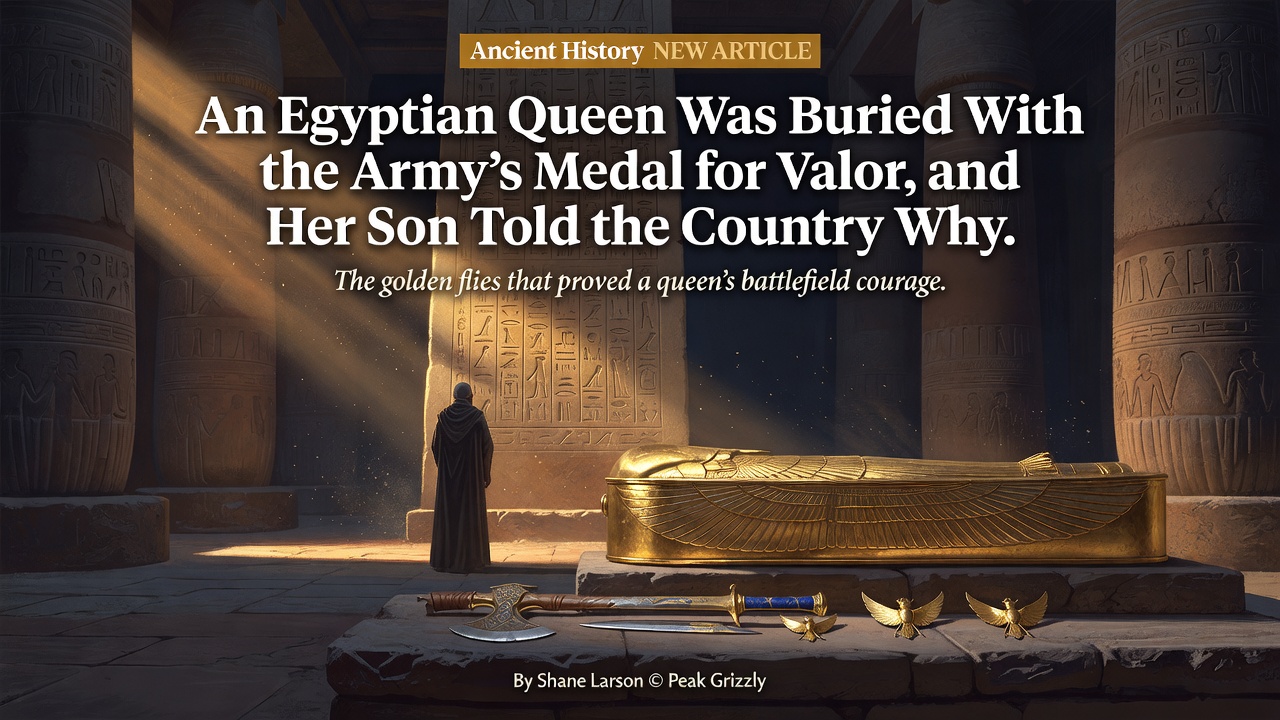
In the early months of 1859 a gang of workmen was digging on the hillside of Dra Abu el-Naga, on the west bank of the Nile opposite Luxor, for a Frenchman most of them had never met. Auguste Mariette had been running Egypt's new Antiquities Service for less than a year, by letter, from Cairo, through foremen. Two years earlier the same slope had given up the plain coffin of a king named Kamose. In 1859 it gave up a gilded coffin with a lid carved as a pair of folded wings, and the name on it was Ahhotep, with a queen's titles after it.
What happened next comes mostly from Mariette's own telling, which means it has the shape of a good story and some of its details should be held loosely. The provincial governor heard that gold had been found, had the coffin brought to him, and had the mummy stripped so the jewelry could be got at. The body was not kept. The treasure went onto a boat for Cairo as a gift to the viceroy; Mariette took a steamer south, met the boat on the river, boarded it, and took the treasure by something close to force. The objects survived and are in the Egyptian Museum. The queen herself went into the river or the rubbish, and nobody wrote down which.
Three flies on a chain
The coffin held a ceremonial axe of bronze and gold with the name of King Ahmose on it, its blade carved with a king striking down an enemy and, on the other face, a griffin, a creature that belongs to the art of Crete more than to Egypt. It held a dagger with a gold hilt, also Ahmose's, bracelets, a broad collar, two model boats of gold and silver, and a few pieces naming Kamose. And it held a chain of gold from which hung three large flies, each the length of a finger, wings spread flat, bodies worked with a simplicity that still looks modern.
The flies were a decoration. New Kingdom texts speak of the gold a king gave to soldiers who had distinguished themselves, and when those soldiers listed what they had received, flies appear beside gold lions, bracelets and collars. The fullest such list belongs to a man from Elkab named Ahmose Pennekhbet, who served this royal family across several reigns and recorded in his tomb the lions and flies he had been given. Why a fly? The usual modern answer is that the fly is the creature that cannot be driven off, that returns to the attack however often it is swatted, and that a soldier decorated with flies was being praised for persistence. No Egyptian text says so, and the explanation should be labeled the guess it is. What is not a guess is that the fly was a military honor given to fighting men, and that three of them went into the grave of a woman.
What her son said
The same queen appears on a tall limestone stela her son set up in the temple of Amun at Karnak, found by Mariette's workmen a few years after the coffin. Most of it is what a royal stela usually is: the king praised, his gifts to the god listed. Then, near the end, the king addresses the people of Egypt directly and tells them to honor a woman. He calls her the king's mother and the lady of the land. He says she has cared for Egypt and looked after its soldiers, that she has guarded it, that she brought back the people who had fled and gathered in those who had deserted, that she pacified Upper Egypt and drove out its rebels. Then he names her: Ahhotep.
Kings honored their mothers constantly, in the formal way, with a name in a cartouche and a statue beside their own. They did not say that she had held the army together and put down a rebellion. In fifteen centuries of Egyptian royal inscription no other king said anything like this about his mother. The stela is a political document, composed to be read aloud to a court, and it should be read as one. But a king does not invent a mother's record of service out of nothing, in the temple of the state god, in front of people who had lived through the years he was describing. Something happened in Upper Egypt during Ahmose's reign that his mother handled, and he thought it worth telling the country so.
The gaps in the story of three men
The founding of Egypt's New Kingdom is usually told as a sequence of men. Seqenenre Tao, a Theban king ruling a strip of the Nile between a foreign dynasty in the Delta and an African kingdom in Nubia, went to war against the Hyksos and died of wounds to the head that are still visible in his skull. Kamose, his brother or his son, took the war north and vanished from the record after three years. Then Ahmose took Avaris, the Hyksos capital, pursued its rulers into Canaan, turned south and broke Kerma, and founded the state that would rule from the Euphrates to the Fourth Cataract for the next four centuries. It is a good story and it is not wrong.
Ahmose
It has two holes in it, and the record is quite clear about where they are. When Seqenenre died, in his forties, his widow was in her thirties and his eldest child was at most seven. When Kamose disappeared, the boy who took the throne was perhaps ten years old, perhaps younger. Somebody governed Thebes in those years, kept the army fed, kept the nobles from making their own arrangements with Avaris, and kept a war alive until a child was old enough to fight it. The Karnak stela says who. The phrases about bringing back fugitives and gathering deserters are not the language of a general leading a charge. They are the language of a regent holding a kingdom together through a desertion crisis, or a mutiny, or a revolt in the south, while the king was a minor.
That is the honest limit, and it should be stated. Nothing shows Ahhotep in command of troops. The flies may have been her son's gift to her, as king, for the regency rather than for any act of arms. Specialists are not even agreed that the queen in the 1859 coffin is the queen on the stela, since a second, larger coffin of an Ahhotep was found in the royal mummy cache at Deir el-Bahri in 1881, and there may have been two women of the name, or three. The warrior queen of the historical novels is not in the evidence. What is in the evidence is harder than fighting: a woman who held Thebes while a boy grew up.
Her daughter bought a priesthood
The pattern did not end with Ahhotep, because the dynasty's men did not stop dying. Ahmose died in his mid-thirties. His widow, Ahmose-Nefertari, who was also his sister, did not retire to a palace. A second stela from Karnak records a transaction in which she acquired, with an endowment of land, goods and staff, the priestly office of God's Wife of Amun, to be held by her and her heirs. A queen's household became an institution with its own estate, passed down the female line. It came to Hatshepsut two generations later, and it was still being held, by the priestess-rulers of Thebes, nine hundred years after Ahmose-Nefertari first bought it.
She dominated her son Amenhotep I's reign, and after her death she and he were worshipped as gods by the workmen who cut the royal tombs, in their village at Deir el-Medina, for some four centuries. They carried her statue in procession and brought their disputes to it. In their tomb paintings she has black skin, the color of Osiris and of the Nile soil, the color of rebirth. Behind both women stood a grandmother, Tetisheri, the daughter of two commoners, whom Ahmose honored with a pyramid at Abydos and a stela recording the decision to build it. He honored no male ancestor there. The dynasty looked back and saw a woman.
Put the facts together and the shape of the thing appears. A small kingdom at war, whose kings died young, needed a source of authority that would not die with the king, and inside a hereditary monarchy the only candidate was the king's mother or the king's wife, who in this family was usually also the king's sister and carried the royal blood herself. The dynasty used her because it had to. Then, because it had used her, it gave her titles, estates, a priesthood and public honors, and those things did not go away when the emergency did. Half a century after Amenhotep I died, a king's daughter named Hatshepsut, regent for a boy king, took the double crown in her own name. She did not invent the idea that a woman could govern in Thebes. She was born into a family that had been doing it for three generations, and the monuments that said so stood in her own temples.
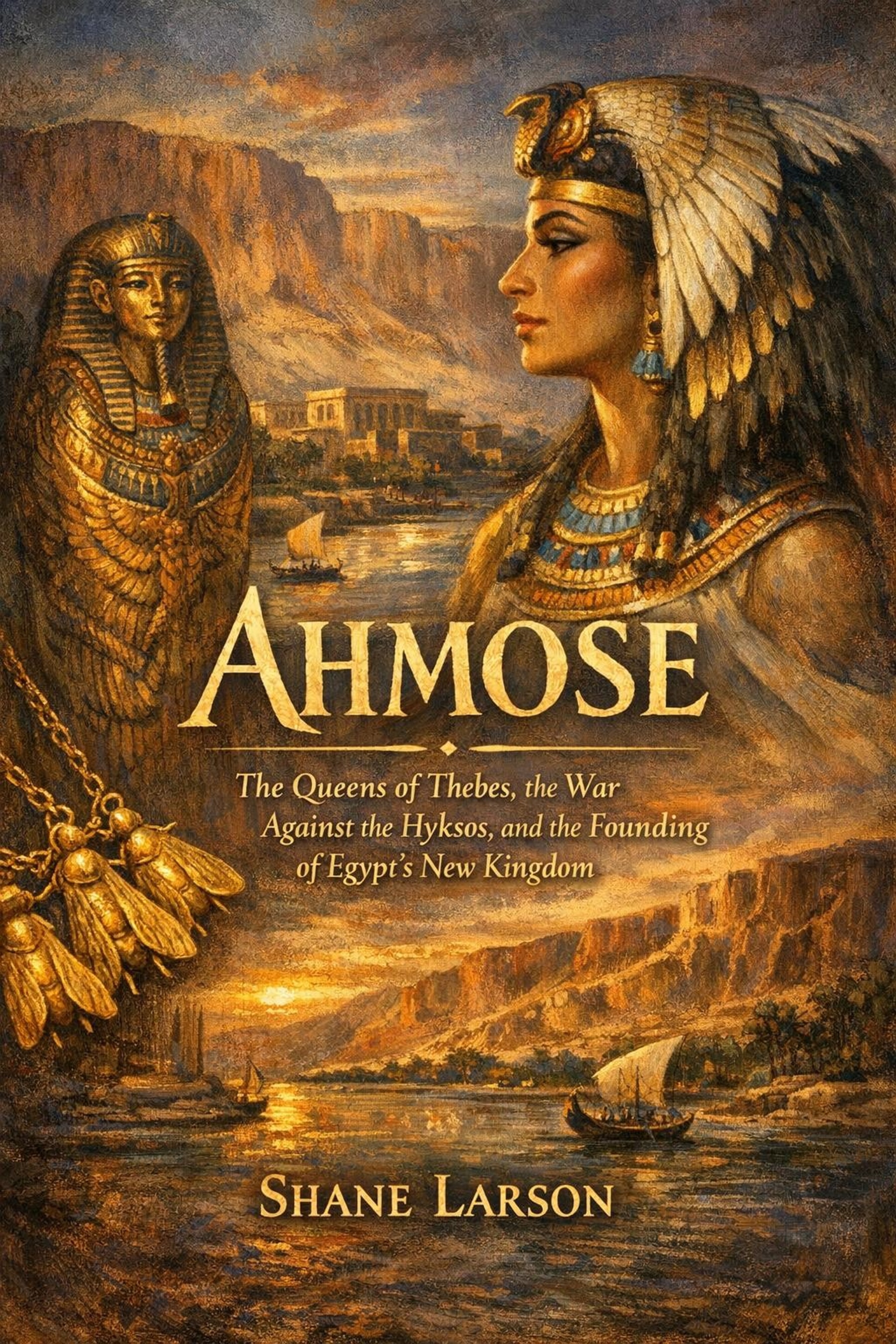
*Ahmose: The Queens of Thebes, the War Against the Hyksos, and the Founding of Egypt's New Kingdom* follows this family across four generations, from Tetisheri to Amenhotep I, with the queens as its subject rather than its backdrop. The war is told from Thebes and compressed, since this house's *The Hyksos* already tells it from Avaris at length; the regency, the burial, the Abydos pyramid, the God's Wife of Amun and the cult at Deir el-Medina get the room popular accounts usually deny them. Every source is named with its nature, every disputed point is presented as a dispute, and where the record is silent the book says so.
Ahmose
New posts and releases, straight to your inbox. No spam, unsubscribe anytime.