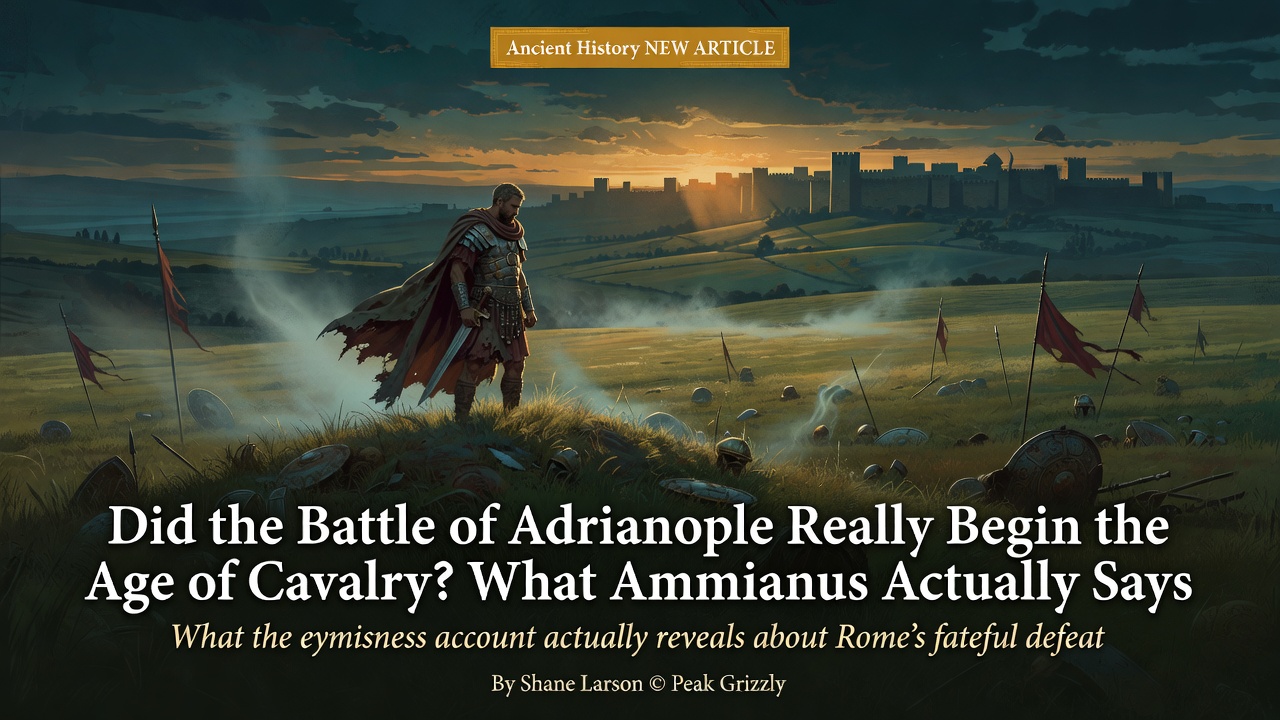
Did the Battle of Adrianople Really Begin the Age of Cavalry? What Ammianus Actually Says
November 5, 2026 · 7 min read
In 1885 a young Oxford historian named Charles Oman published an essay on the art of war in the Middle Ages. He expanded it into a book in 1898, and it became the standard account of medieval warfare in English for half a century. Its argument had a hinge, and the hinge was a battle fought outside the city of Adrianople in Thrace on 9 August 378. On that afternoon, Oman wrote, Gothic horsemen rode down the Roman infantry, an emperor died, and a thousand years of warfare changed shape. The legion was finished. The mounted warrior was now queen of the battlefield, and would stay so until Swiss pikemen and English bowmen unseated him in the fourteenth century.
It is a tidy story. It has been repeated in battle compendia, in classroom surveys and in the captions of museum displays ever since. Almost no one who has studied the late Roman army in the last fifty years believes it, and the reason is simple: the one good source for the battle describes something else.
What Ammianus describes
Nearly everything known about Adrianople comes from Ammianus Marcellinus, a retired staff officer from Antioch who wrote his history in Rome in the early 390s and ended it with the battle. He was not there. He talked to men who were, and he says he walked ground in Thrace afterward. He was a soldier writing about soldiers' business, and his account of 9 August is the most detailed description of any late Roman battle that survives.
Here is what it says. Valens left his baggage under the walls of Adrianople and marched out at dawn with his whole army toward the Gothic wagon circle, which scouts had reported some eight miles away on rising ground. The scouts had also reported the Gothic force at about ten thousand. That was an underestimate, and the reason is the key to the day: a large part of the Gothic cavalry, the Greuthungi under Alatheus and Saphrax together with their Alan allies, was away from the camp foraging. The Romans marched over rough ground in August heat and reached the wagons at about the eighth hour, early afternoon, without having eaten or drunk. The Goths had set fire to the countryside to make the heat worse. Then Fritigern sent envoys, and the Romans began to deploy from their marching column while the talks went back and forth: the cavalry of the right wing came up first, the infantry formed in the center, and the left wing was still arriving along the road.
The battle began by accident. Two units of skirmishers, under officers Ammianus names as Bacurius and Cassio, attacked the wagons without orders while Richomeres, one of the western generals, was on his way to the Gothic camp as a hostage for the talks. At that moment the foraging cavalry returned. Ammianus likens its arrival to a thunderbolt. It struck the Roman cavalry on the flank and broke it. Meanwhile the Roman left wing, which had pushed forward as far as the wagons, found itself unsupported, was surrounded, and was destroyed. With both wings gone the infantry of the center was pressed in on itself until, Ammianus says, men were packed so tightly that they could not draw their swords or raise their arms. The dust hid everything. The Roman line held in that condition for hours and broke at dusk. Valens was last seen among the common soldiers. His body was never found, and Ammianus gives two accounts of his death, an arrow in the press or a farmhouse the Goths burned with the emperor inside, without choosing between them. Barely a third of the army got away.
Ammianus reached for the only comparison available to a Roman and said the annals recorded no such disaster since Cannae. He meant the scale. He also meant the cause, because in both cases a Roman commander had chosen to fight a battle he did not need to fight. He did not say that a new kind of warfare had arrived, and nothing in his account suggests he thought so.
Where Oman's story goes wrong
Read against the source, the cavalry thesis fails on four counts, and the historians who dismantled it, Thomas Burns in the 1970s, Peter Heather and Hugh Elton after him, made each of them.

Adrianople
First, the Gothic army was not a cavalry army. The Tervingi who formed the bulk of it, and who held the wagon circle, were farmers from the Danube lands who fought on foot. The horsemen who decided the day were the Greuthungi and the Alans, and they decided it because of when they arrived, not because of what they were. Had they been in camp at dawn, the scouts would have counted them, and Valens might have listened to the letter from his nephew Gratian asking him to wait. The decisive fact at Adrianople was an intelligence failure, not a new weapon.
Second, the Romans had cavalry of their own, and a great deal of it. The late Roman field army had been building up its mounted arm for a century before 378, under emperors who had learned the lesson on the Persian frontier. The Roman cavalry at Adrianople broke because it was struck on the flank while half-deployed, which is what happens to any cavalry struck on the flank while half-deployed.
Third, the Roman infantry was not shown to be obsolete; it was shown to be badly used. An army that has marched eight miles in August without water, formed up from column under the eyes of the enemy, and lost both its wings before its line is complete, will be beaten by anyone. The men in the center fought in that condition until nightfall. That is not the performance of a finished military instrument. It is what a good infantry does when its commander has given it no chance.
Fourth, nothing changed afterward. The late Roman field army had won most of its battles against the Goths before 378, including the hard-fought day at the Willows a year earlier, and it went on winning them after. Theodosius rebuilt the eastern army, with Goths in it, along the same lines as before. The infantry-heavy structure of the field armies is still visible in the Roman army lists compiled decades later. No Roman commander responded to Adrianople by converting his regiments to horse. The medieval knight has a long history of his own, and it does not start on a hillside in Thrace.
Why the myth lasted
The cavalry thesis survived for a century because it answered a question people wanted answered. If Adrianople was the day the legion died, then the fall of the western empire a hundred years later has a clean beginning and a military explanation. Oman wrote at a time when military history was expected to produce turning points, and Adrianople, with its dead emperor and its two-thirds casualties, looked like one.
The battle was a turning point, but not the one Oman named. What changed after 9 August 378 was political. An undefeated Gothic people was now inside the frontier, and it could neither be destroyed nor removed. Four years later, on 3 October 382, the empire settled it there by treaty, on its own land, under its own leaders, with military service as allies rather than as recruits dispersed among Roman units. Rome had never granted terms like that before. Whether that treaty began the chain of events that ended in the sack of Rome in 410 is a real argument, and historians still have it. Whether cavalry defeated infantry that afternoon is not.
The lesson of the sources is the smaller one, and the truer. An emperor in a hurry, a scout who counted the wrong camp, an army deployed from the march in the heat, and a force of horsemen that came back from foraging at exactly the wrong moment. Ammianus knew what he was describing. It took the modern world a long time to read him.
*Adrianople: The Goths, the Huns, and the Battle That Broke the Roman Army* is a narrative history of the Gothic crisis of 364 to 382, with the battle at its center: the brother-emperors who divided the empire, the Gothic world north of the Danube, the Huns who broke it, the crossing of 376 and the corruption on the riverbank that turned it into a war, the battle as closely as Ammianus allows, and the treaty of 382 that changed Roman frontier policy for good. It names the witness in every scene, gives every army figure with its source, and tests the three famous claims about the battle, the fall of Rome, the death of the legion and the victory of cavalry, against what the evidence will bear.
Adrianople
New posts and releases, straight to your inbox. No spam, unsubscribe anytime.